
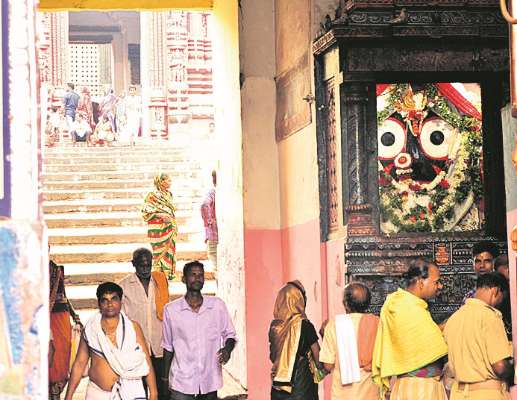
Inside the Jagannath Temple, different idols of Lord Jagannath include Patitapaban Jagannath at the main entrance for devotees who cannot enter, Tirtheswar Jagannath symbolizing the Lord of pilgrimage sites, Neelamadhab Jagannath representing the ancient blue-colored deity, and Bata Jagannath at the Bata Ganesh temple, symbolizing the deity as a protector. Each idol emphasizes different aspects of Lord Jagannath’s divinity, providing various ways for devotees to connect and worship.

Patitapaban Jagannath – installed in Gumuta Griha at the main entrance of the temple, need of installation occur because of Gajapati Rama Chandra Dev (1732 to 1743 AD) had married one Muslim girl under circumstance occurred. He became irreligious, had no permission to enter temple premises & get the darshan to Shri Jagannath. But King was devoted to Lord Jagannath could not stay happy even if ruptured from Hinduism. He had obedient to Lord Jagannath Culture, for these reason pundits of Lord Jagannath Temple commiserate to Gajapati , and installed bigraha of Lord Jagannath near Singhadwara. King now privileged to get the darshan of Lord Jagananth from the grand road, known as Badadanda. From that day installed bigraha worshiped as Patitapabana.
Tirtheswar Jagananth – One another image installed near Western Gali of the Temple. The small shrine known as “Chardham Mandir”, some also call it Rameswar Mandir. Shri Jagannath bigraha ( idol ) is installed along with the reprehensive images of Badrinath, Rameswaram and Dwarika. It is said that Sankaracharya sacred all four iamges in this small temple. Locally told and believe that anyone has the ‘darshan’ of four deities her, devotee will have the benefits of Char Dham. The idol installed here is worshipped as Titheswara Jagannath.
Neelamadhab Jagannath – 3ft hight idol of Shri Jagananth is installed in Neelamadhab Temple ( Bhitara Bedha ) . Lord Jagananth has worshiped by the side of Neelamadhab Mahaprabhu. Neelamadhab is main deity of this shrine.
Bata Jagannath – 5ft height Lord Jagnnath named as Bata Jagannath according to name of Bata Brukhya ( Kalpa Bata ) . The idol has placed just near to south of Kalpabata. On the day of ‘Snana Purnima’, the Anasara rituals are observed in the temple of Bata Jagannath, the rituals of nabakalebara is also observed in the temple Bata jagannath. The ‘Pinda’ of bata Jagananth is buried in koili Baikuntha. Interestingly Arnaprasad is not offered to Bata Jagananth, sevaka offer dry ‘bhoga’ includes ‘Ballav’, ‘Kakara Pitha’ and Kora. Bhakti Cult saint poet Atibadi Jagananth Das had written Odia Bhagabata in front of Batabihari Jagannath. Chaitanya Mahaprabhu had met Jagananth Das and bestowal the title ‘Atibadi’ for great spiritual expositions on Bhagbata Odiya. Bata Jagannath is also worshiped as “Bhagbata Kalia” in the Grand Temple ( Bada Deula ). charya Baladev Vidyaratna had written here his famous commentary on ‘Brahma Sutra’, known as ‘Govinda Bhasyam’. Chandan Hajuri (Chakhi Khuntia ) one great patriotic poet had written many beautiful vajan near Bata Jagannath.
The concept of the four idols of Lord Jagannath inside the Jagannath Temple reflects the deep spiritual diversity and inclusiveness of Jagannath culture. These four forms—Patitapaban Jagannath, Tirtheswar Jagannath, Neelamadhab Jagannath, and Bata Jagannath—symbolize different aspects of the same Supreme Lord, allowing devotees to connect with Him in multiple ways.
Rather than being limited to a single form, Lord Jagannath is worshipped in varied manifestations across the temple परिसर, each representing accessibility, protection, pilgrimage, and ancient divinity. This aligns with the broader tradition where Jagannath is seen as a universal deity beyond boundaries of caste, place, or status.
In conclusion, these four idols emphasize that Lord Jagannath is not confined to one image or ritual but is present everywhere for every devotee. They beautifully express the philosophy that the Lord is all-inclusive, ever-accessible, and eternally compassionate, making the Jagannath tradition unique in Hindu worship.
In the Nata Mandap (Dance Pavilion) of the Bhubaneswari Temple, on the right side, there exists a small shrine dedicated to the worship of Mother Sasthi, Savitri, and Gayatri. This shrine is a modest temple-like structure. It is believed that the entire family of Goddess Sasthi is worshipped here, and some devotees also worship the deity as Manasa Devi.
Goddess Sasthi is particularly venerated for the longevity and well-being of children. On their birthdays, children are blessed in her name. In artistic depictions, Sasthi Mata is often shown with 300 children, with one child contentedly sleeping on her left lap.
Additionally, during the Amavasya (new moon day) in the month of Jyestha, married women observe the Savitri Brata at this temple. They engage in this ritual to pray for the long life and well-being of their husbands. This observance is a significant cultural and religious event for the devotees.
The Kalpabata or the big banyan tree is said to have existed Kalpataru – Kalpabriksha – Kalapabata since long. this tree Kalapa Bata finds mentions in Skanda Purana and Brahma Purana. Skanda Purana says that in the beginning of the present Kalapa ( the span of time between two deluges) Bishnu and Laxmi were in this Pursottam Khetra floating in the water. At that time a sage Markandeya, who supposed to live for seven Kalpas, was also floating and he was also searching for a shelter. He could find the banyan tree and came near to it., till he heard the voice of a child, which directed to him closer. He saw Bishnu and Laxmi. Bishnu instructed him to limb up the tree and enter the mouth of the child. Markandeya did accordingly and saw the entire universe in the abdomen of the child. Later Bishnu advised him to dig a pond for him at north-west side of the tree.
Around the holy tree Kalpabata, devotee find the temples of Bateswara, Batakrushna, Balamukunda, Bata Mangala, Bata Narayan, Bata Ganesha, RadhaKrushna, Bata Jagananth, Panchu Pandab and Mahadev.
Virtue of Kalpabata Tree is described in many Hindu Spiritual Mythology like Sknada Purana, Brhma Purana, Tirtha Chintamani, Bhagabata Mahapurna, HariBansh, Bhabishyaparba, Pramabhakti, Brhmagita, Chandrakala, Rasika Harabali, Saragupta Gita, Tulabhina and Astagujari.
Skanda Purana also depicts that Sabara King Biswabashu was worshiping Nilamadhab under this tree. The Kalpa Brukshya is also found mention in Brahna Purana that say it was never destroyed even after the end of Kalpa. The Pilgrims and visitors circumambulate the tree along the narrow passage and it believed that the tree divine power of wish fulfilling.
It is said that this holy kalpabat appeared on the Kartik Shukla Triodashi date. Kalpabat’s birthday is celebrated on this date. Traditionally, the Brahmins bathe the Batr deity by bathing them with Panchamrit and wear new clothes. Jagannath and Kalpabat are no different. Kalpabot is associated with the worship of Jagannath. It is impossible to worship the Lord without Kalpabata. When Thakur arrives on Bahuda Day, Bandapana ritual occur . The Lord does not enter the Shrimandir without the Bandapana. This shows the greatness of Kalpabat.
Among all trees, I am the peepal tree, the sacred fig tree. Among the celestial sages, I am Narad. Among the celestial musicians called Gandharvas, I am Chitrath, and amongst the perfected beings known as Siddhas, I am the sage Kapil.
aśhvatthaḥ sarva-vṛikṣhāṇāṁ devarṣhīṇāṁ cha nāradaḥ gandharvāṇāṁ chitrarathaḥ siddhānāṁ kapilo muniḥ
Bhagavad Gita: Chapter 10, Verse 26
Amongst trees I am the peepal tree (sacred fig tree); of the celestial sages I am Narad. Amongst the gandharvas I am Chitrath, and amongst the siddhas I am sage Kapil.

Western corner of Shri Jagnnath Temple between Shri Nilamadhab and Shri Laxmi Mandir, Temple of Shri BedhaKali ( Guhya Kali / Vadra Kali) is situated. This particular corner was dense with trees and shades, devotees afraid to visit the place and most were died by fear. Time of Marhatta reign, by the effort of Baba Brhmachari, Murti ( Bighra) was placed from the protection from wrath of Jantra Kali / Bedha Kali. After the sleeping ( Pahuda) of triad, Maa Bedha Kali manifest herself to protect the temple. Bhadra Kali is Param Baisnabi, murty was built with jhuna and oil called “Oshua”, original murti (Statue) is placed behind. There is a hole right side of current statue, all the offering like flower and prasad is offered to that way.
The “Baisi Pahacha,” also known as the “flight of twenty-two steps,” holds great significance within the Shree Jagannath temple complex, not only for its architectural importance but also for its profound impact on devotees’ lives. Starting from the Simha Dwara (eastern gateway of the outer enclosure), the Baisi Pahacha ascends into the inner enclosure of the temple.
While the historical records or puranic literature do not provide an exact construction date, legends attribute its creation to King Bhanudeva. The steps’ dimensions vary, with the middle 15 steps ranging from 5 feet 10.5 inches to 6 feet 3 inches in width and 6 to 7 inches in height. The remaining 7 steps are smaller in length and width. These steps are constructed using felspar and khodalite materials.
On the southern side of the Baisi Pahacha, notable features include the revered Shiva Linga named Kashi Biswanath, as well as idols of Ramachandra, Nrusimha, and Ganesh. The exact history and mystery surrounding these steps are not widely known. However, they are held in high regard by the people, believed to possess a profound spiritual essence.
Various sacred rituals and ceremonies take place on these steps on different days and occasions. It is believed that during the Ratha Yatra, numerous gods, goddesses, demi-gods, celestial beings, ancestral souls (near Pitrushila), Chitragupta (the minister of Yama Raj), and Yamadootas (near Yamashila) descend upon these steps to witness the pahandi procession of Shree Jagannath.
On the Chaturdashi tithi of the dark fortnight in the month of Margashira (December), Madana Mohan, the representative deity of Shree Jagannath, performs pinda dana (a ritualistic offering) on these steps to honor His ancestors, namely Nanda and Yashoda, Devaki and Vasudeva, and Kaushalya and Dasharatha. Madana Mohana also offers pinda dana on this Baisi Pahacha at Gundicha Temple since King Indradyumna and Queen Gundicha were childless.
As devotees ascend the steps (Baisi Pahacha), it is customary to step on a stone called Yamashila, which is engraved into the third step. It is believed that this stone frees individuals from the consequences of punishment by Yama, the god of death. However, one must not step on this stone on the way back, as it would diminish the merits of the darshan (sacred viewing) of Shree Jagannath.
The small rough stone on the seventh step is known as Pretashila or Pitrushila. People who believe in liberating the souls of the deceased place Mahaprasad (the holy rice offered to Shree Jagannath) on this stone and leave anna (rice) as an offering to feed their ancestors.
 This Ganesha Temple is situated at Western Side of Sri Mandi near temple of Sri Sakhi Gopal. This ganesha is know as Kanchi Ganesha, Uchista Ganesh, Bhanda Ganesha, Kamada Ganesh, Tantrik Ganesha. Bhitaracha Mohapatra is the servitor to the God Sri Ganesha. It is said that Gajapati Purushottam Dev after victory over Kanchi state, while returning Odisha he brought Prince Padambati, along with Gold, Jewels and many rare idols with him. Except Princess Padmabati, he offered all the things to Sri Jagannath.
[wc_row][wc_column size=”one-half” position=”first”]
Bhanda Ganesha Dhyana Mantra – Mukti Chintamani https://t.co/hBU1tzaRO4 pic.twitter.com/uI0eHk8NIw
— PURIWAVES (@PURIWAVES) September 20, 2016
[/wc_column][wc_column size=”one-half” position=”last”]
ଭଣ୍ଡ ଗଣେଶଙ୍କୁ ମୁଣ୍ଢ ଳଗାଅରେ ଧନ ।
ପାର୍ବତୀଙ୍କ ବିଭାକାଳେ ହେଲେ ଏ ବରଣ ।।
– ବେଢା ବୁଲା https://t.co/hBU1tzaRO4 pic.twitter.com/buQEQYvjqm— PURIWAVES (@PURIWAVES) September 20, 2016
[/wc_column][/wc_row]
Kanchi Ganesha was one of them. During the war , the king of Kanchi was ensured Sri Ganesh. Shri Ganesh took part in the battle on behalf of Sri Kanchi during the night war. Sri Ganesh was ignorant about the involvement of Lord Jagannath and Balabhadra in the war on behalf of Purushatam Dev, King of Odisha. It is said that in the war, white horse of Lord Jagannath became a cat and the mount of Sri Ganesha ie mouse fled aways from the battle fled away from the battle ground. After knowing the involvement of Lord Sri Jagannath in the war, Sri Ganesha apologized before the Lord Jagannath and withdraw support from the king of kanchi. After achieved victory, the Ganapti king brought Ganesh with him, subsequently Ganesha has been established in Sri Jagananth Temple. This Ganesha is worshiped for the fulfillment of desires. Specialty of this idol is that a women seated on the left thigh of Ganesh and his trunk is placed at her vaginal site.
 Satyanarayana , the temple houses, a life size standing image of Visnu and four armed with Sankh, Gada and Abhaya Mudra. The image is black colour with Kirita crown on head and is very much impressive. The artistic value is very high and similar image reminds us the worship of Alaranath Bishnu image at Brahmagiri. Similar images are found in Prachi Valley and at artistic point of view can be assigned to the post 14th century as a number of such images and temples of Madhava have been constructed in the Prachi Vally. This is one of the finest specimen of Orissan images of medieval period. The Satyanarayana ‘Vratt Katha’ comprises five chapters, with clear message that the followers of Shri Satyanarayana Bhagavan must lead the life of truthfulness both in deed and words. The Katha guides the followers to treat every one with equality, love and compassion and remain free from pride and ignorance. The story goes that “ a king who out of ignorance, refused to pray God in the company of poor shepherd .He ignored their Prasad, consequently,lost his empire, family and wealth which he regained only upon performing the puja together with poor shepherd. The Satyanarayana puja performed with clear understanding and “Bhaav” channels of our mind to good thoughts, helping us overcome negative thoughts and deeds.

The Hastidwara (Aisvraya) or the elephant gate on the north opens upto aflight of 13 steps of Khandalite leading to inner enclosure, the deities of Lokanth, Uttarayni, Laxmi, Nrusimha and Varaha and Sitala have been installed in the outer enclosure. A sacred well known as Suna Kuna exists here. The water of the well is so sacred that it is reserved for the bath of deities only once in a year during Snana Yatra (festival) that is performed with 108 pitchers of water collected from this well during the annual cycle of the festivals on the full moon day of Jyestha (june). On the eastern side stands a banyan tree on a raised platform. On right, inside the outer enclosure located, the Koili Vaikuntha (the Heaven of Vishnu). And a sacred place where during the Navakalebara period, the old images of the deities consecrated in Madhavikunja. The place is filled with Tulasi plants and almost all pilgrims visit this hallowed part.

As per Saktaism Five mother worshiped as 1) Saraswati Mata 2) Gayatri Mata 3) Savitri Mata 4) Sasthi Mata 5) Bhubaneswari Mata. These five Goddess are well known as first mothers of Universe. In the inner chamber of temple Mata Bhubaneswari is established and also addressed as Kamala / Satyabhama. In the the outer chamber at the left side, the Goddess Saraswati, God Nrusingh and at right side Goddess Sasthi, Savitri Gayatri and Manasa are being worshiped.
During beginning of 1900 AD the Bhubaneswari Temple was built. The image of Goddess bhubaneswari having 5 feet height was established in the temple. Mother Goddess Bhubaneswari is one of the Ten renowned Goddess namely (Ten Wisdom) Dasa Mohavidya. The height of the temple is 35 feet. The Goddess having having four hands decorated with weapons like passa ankush with blessing style of Abhaya and Barada mudra.
Goddess Saraswati is established in a small Temple at the entrance Temple ( Nata Mandap) of Goddess Bhubaneswari Temple. Saraswati Goddess sits on the back of her mount swan. Height of the Goddess is one foot and a image of God Nrusing with one foot height is placed at the right side of Goddess. A special cake ( Basant Kakara Pitha ) is offered to Goddess on the Day of Basant Panchami and at evening twenty two coconuts were offered to Goddess. The Madala Panji ( Temple Anecdote ) is worshiped at the front of Goddess.

The Jagananth Temple, nestled in the spiritual heartland of Odisha, stands as a testament to centuries of devotion and reverence. Within its sacred confines lies a treasure trove of divine manifestations, each carrying its own unique aura of mysticism and significance. Among these revered forms is the Kalpabata Ganesha, a stone-carved deity whose presence embodies the fulfillment of desires and the auspicious beginnings of new journeys.
Situated on the southern side of the Jagananth Temple, near the revered Kalpabata, or the Desire Fulfilling Banyan Tree, the Kalpabata Ganesha statue commands attention with its serene countenance and striking symbolism. Crafted from stone and facing towards the south, this manifestation of Lord Ganesha stands with four arms, each adorned with symbolic elements that speak volumes about his divine attributes.
In his right hands, he carries a Rudraksha garland, symbolizing spiritual awakening, and a Lekhani, or pen, embodying the power of knowledge and wisdom. A broken elephant tooth, a distinctive feature of Ganesha, further accentuates his unique identity and divine grace. Meanwhile, his left hands grasp a Parshu, a weapon representing protection, and a Ladu, a sweet delicacy symbolizing the sweetness of fulfillment.
At the feet of Kalpabata Ganesha sits his loyal vahana, or mount, the mouse, a quintessential symbol in Odishan sculpture. This humble creature, placed on a granite pedestal, not only serves as a companion to the Lord but also signifies the importance of humility and perseverance on the spiritual path.
Venturing deeper into the inner courtyard of Sri Mandir, one encounters the majestic presence of Bata Ganesha, another divine manifestation revered by devotees. Situated at the root of the Kalpabata tree, this shrine stands tall with a height of 12 feet, while the idol of Bata Ganesha itself measures 4 feet in height. Seated on his throne in a posture of tranquil grace, Bata Ganesha radiates a sense of peace and fulfillment to all who come before him.
Like his counterpart, Bata Ganesha is depicted with four arms, holding a Rudraksha mala and a broken elephant tooth in his right hands, and a Parshu and Ladu in his left hands respectively. His mount, the mouse, sits faithfully at his feet, its presence imbued with symbolic significance and spiritual resonance.
Legend has it that Bata Ganesha possesses the power to fulfill all desires, much like the Kalpataru, the wish-fulfilling divine tree. Devotees flock to his shrine, seeking blessings and guidance in their spiritual endeavors, confident in his benevolence and grace.
The daily rituals and sacred observances of Bata Ganesha are meticulously managed by the administration of the Jagananth Temple, ensuring that his divine presence remains a beacon of hope and inspiration for all. During the auspicious month of Bhadraba Masa, Ganesha Chaturthi is celebrated with fervent devotion, as devotees pay homage to the Lord, seeking his blessings for prosperity and fulfillment.
In the sanctum of Sri Mandir, where time seems to stand still and divinity permeates every corner, the presence of Kalpabata Ganesha serves as a reminder of the eternal bond between the divine and the mortal realm, offering solace, guidance, and the promise of fulfillment to all who seek it.
A Ganesha Temple situated near Jalakrida ( Swiming Pool ) Mandap at Jagannath Temple. This Ganesha is made of black granite stone and faced towards south, He has eight hands holding snakes. This idol is in standing posture and adorned with Rudraksha Garland, elephant tooth, nut & and one hand in blessing posture.
