
Goswami Tulsidas, who was blessed with the divine vision of Lord Shri Ram, composed the Hanuman Chalisa, in which he wrote that by remembering Hanuman, even the most ignorant, desire-bound people can cross the ocean of suffering. In this sacred hymn, he clearly affirmed that chanting the Hanuman Chalisa is as powerful as a divine mantra, capable of relieving devotees from all worldly difficulties.
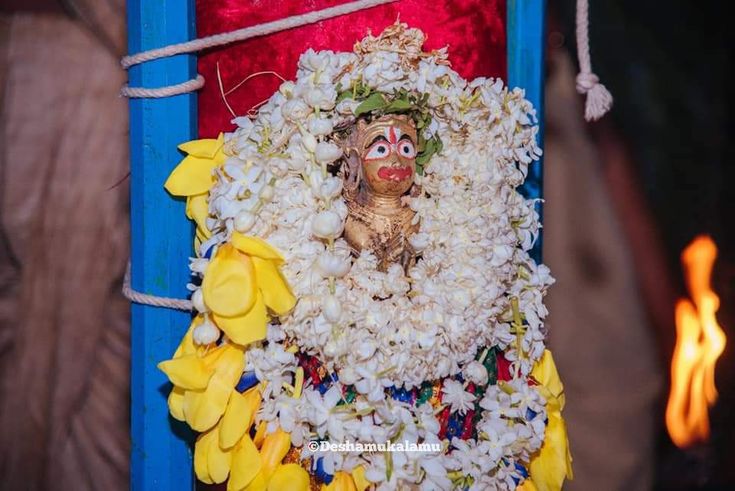
In Odisha, Hanuman Jayanti is celebrated on Mahavishuba Sankranti, which also marks the Odia New Year (Utkal Varsha). On this auspicious day, at the Shri Jagannath Temple in Puri, Hanuman Jayanti is observed with great pomp and devotion. As per the divine command of Lord Jagannath, the Pujapanda Sevayats ceremonially bring Hanuman, who resides in the Southern Room (Dakshina Ghara) of the temple, in a beautifully adorned palanquin (Bimana) to the Jhulan Mandap (swing pavilion).
The four Mahavirs (forms of Hanuman) located at the four gates of the temple, along with the Hanuman outside the southern wall, are taken out in a grand procession. These processions are accompanied by traditional musical instruments such as ghanta (bells), kahali (trumpets), and various types of badya-bajana (percussion instruments). After performing special rituals and invoking divine energy, these idols are taken in a ceremonial march to the sacred site of Dariapari Hanuman.
After the completion of these rituals, special offerings (bhoga) are made at the Jagannath Ballav Math. Devotees gather in large numbers along the path to witness the return of the palanquins, offering heartfelt prayers. Finally, the idols are respectfully brought back and placed near the southern gate of the Jagannath Temple.
Devotees of Lord Ram believe that Lord Jagannath is a form of Shri Ram himself. Where there is Ram, his most beloved devotee Hanuman must also be present. Therefore, several Hanuman idols have been installed at various locations in and around the temple. Scholars and spiritual thinkers believe that Hanuman, with his divine power, protects the temple and the holy land of Srikshetra from natural disasters, including the powerful waves of the ocean.
There are four key Hanuman idols (Mahavirs) at the four main entrances of the temple. Each of them serves as a guardian deity:
- Fate Mahavir – located at the Eastern Gate.
- Kanpata Mahavir or Veer Vikram Mahavir – located at the Western Gate.
- Barabhai Mahavir – located at the Southern Gate.
- Charichakra Mahavir or Tapasvi Mahavir – located at the Northern Gate, who is also known as Ashtabhuja Mahavir (eight-armed Hanuman).
It is believed that because of Kanpata Mahavir, no matter how much the ocean roars, the waves never breach the temple’s boundary wall. Remarkably, the sound of the ocean disappears once inside the temple premises, and this mystery has remained unsolved for ages. Many attribute this miracle to the divine grace of Hanuman.
In addition to these main idols, there are several Hanuman idols within the five kos (approximately 10 miles) of Srikshetra who serve as divine protectors of the region. Among them, sixteen specific Hanuman idols are venerated as the “Shola Murti Hanuman” (sixteen-formed Hanuman), who provide divine protection and blessings. These idols are unique as they do not bear any sindoor (vermilion), unlike traditional Hanuman idols seen elsewhere.
One important Hanuman idol is found in Ananda Bazaar, the sacred marketplace of the temple where Mahaprasad (holy offerings) is distributed. This Hanuman is believed to oversee the process of offering and selling Mahaprasad, maintaining divine order and ensuring that every devotee receives their share without conflict.
Inside the temple’s Natamandap (Dance Pavilion)—an architectural marvel—another Hanuman idol watches over the devotees, ascetics, and sages, ensuring that the darshan (viewing of the Lord) happens in a peaceful, disciplined, and spiritually uplifting manner.
Moreover, on the outer western boundary wall, there is yet another form of Hanuman who silently and faithfully stands guard—watching over the temple and the land of Srikshetra, just as he has for centuries.